xcp_d.workflows.anatomical.surface module
Workflows for processing surface anatomical files.
- xcp_d.workflows.anatomical.surface.init_fsnative_to_fsLR_wf(reg_sphere_available, software, omp_nthreads, name='fsnative_to_fsLR_wf')[source]
Transform surfaces from native to standard fsLR-32k space.
- Workflow Graph

(Source code, png, svg, pdf)
- Parameters:
reg_sphere_available (bool) – True if the registration sphere is available in the input dataset.
software ({“MCRIBS”, “FreeSurfer”}) – The software used to generate the surfaces.
omp_nthreads (
int) – Maximum number of threads an individual process may use.name (
str, optional) – Name of the workflow. This is used for working directories and workflow graphs. Default is “fsnative_to_fsLR_wf”.
- Inputs:
lh_subject_sphere, rh_subject_sphere (
str) – Left- and right-hemisphere sphere registration files.lh_reg_sphere, rh_reg_sphere (
str) – Left- and right-hemisphere sphere registration files for msmsulc.lh_pial_surf, rh_pial_surf (
str) – Left- and right-hemisphere pial surface files in fsnative space.lh_wm_surf, rh_wm_surf (
str) – Left- and right-hemisphere smoothed white matter surface files in fsnative space.
- Outputs:


- xcp_d.workflows.anatomical.surface.init_generate_hcp_surfaces_wf(name='generate_hcp_surfaces_wf')[source]
Generate midthickness, inflated, and very-inflated HCP-style surfaces.
- Workflow Graph
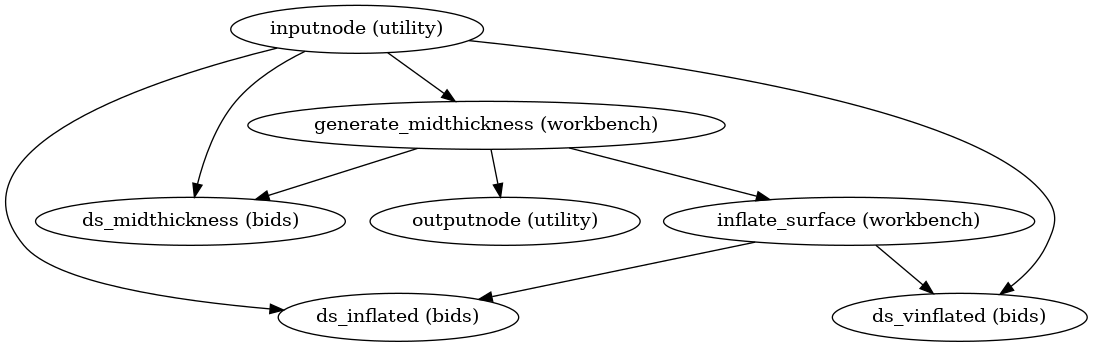
(Source code, png, svg, pdf)
- Parameters:
name (
str, optional) – Name of the workflow. This is used for working directories and workflow graphs. Default is “generate_hcp_surfaces_wf”.- Inputs:
- xcp_d.workflows.anatomical.surface.init_postprocess_surfaces_wf(mesh_available, standard_space_mesh, reg_sphere_available, morphometry_files, t1w_available, t2w_available, software, name='postprocess_surfaces_wf')[source]
Postprocess surfaces.
If DCAN QC is enabled, this will generate a BrainSprite for the executive summary. If process-surfaces is enabled or fsLR-space mesh files are available, then the BrainSprite will use standard-space mesh files. Otherwise, it will use the native-space mesh files.
If process-surfaces is enabled and mesh files (i.e., white and pial surfaces) are available in fsnative space, this workflow will warp them to fsLR space. If process-surfaces is enabled and the mesh files are already in fsLR space, they will be copied to the output directory. These fsLR-space mesh files retain the subject’s morphology, and are thus useful for visualizing fsLR-space statistical derivatives on the subject’s brain. The workflow will also rigidly align the meshes to the MNI152NLin6Asym template, so that they can be overlaid on top of the template for visualization.
As long as process-surfaces is enabled and mesh files (in either space) are available, HCP-style midthickness, inflated, and very-inflated surfaces will be generated from them.
If process-surfaces is enabled and morphometry files (e.g., sulcal depth, cortical thickness) are available in fsLR space, they will be copied to the output directory.
- Workflow Graph

(Source code, png, svg, pdf)
- Parameters:
mesh_available (bool)
standard_space_mesh (bool)
reg_sphere_available (bool) – True if the registration sphere is available in the input dataset.
morphometry_files (list of str)
t1w_available (bool) – True if a T1w image is available.
t2w_available (bool) – True if a T2w image is available.
software ({“MCRIBS”, “FreeSurfer”}) – The software used to generate the surfaces.
name (
str, optional) – Name of the workflow. This is used for working directories and workflow graphs. Default is “postprocess_surfaces_wf”.
- Inputs:
t1w – Preprocessed T1w file. May be in native or standard space.
t2w – Preprocessed T2w file. May be in native or standard space.
template_to_anat_xfm (
str) – Path to the MNI-to-T1w transform file. May be “identity”, for testing purposes.lh_pial_surf, rh_pial_surf
lh_wm_surf, rh_wm_surf
lh_subject_sphere, rh_subject_sphere
lh_reg_sphere, rh_reg_sphere
sulcal_depth
sulcal_curv
cortical_thickness
cortical_thickness_corr
myelin
myelin_smoothed

