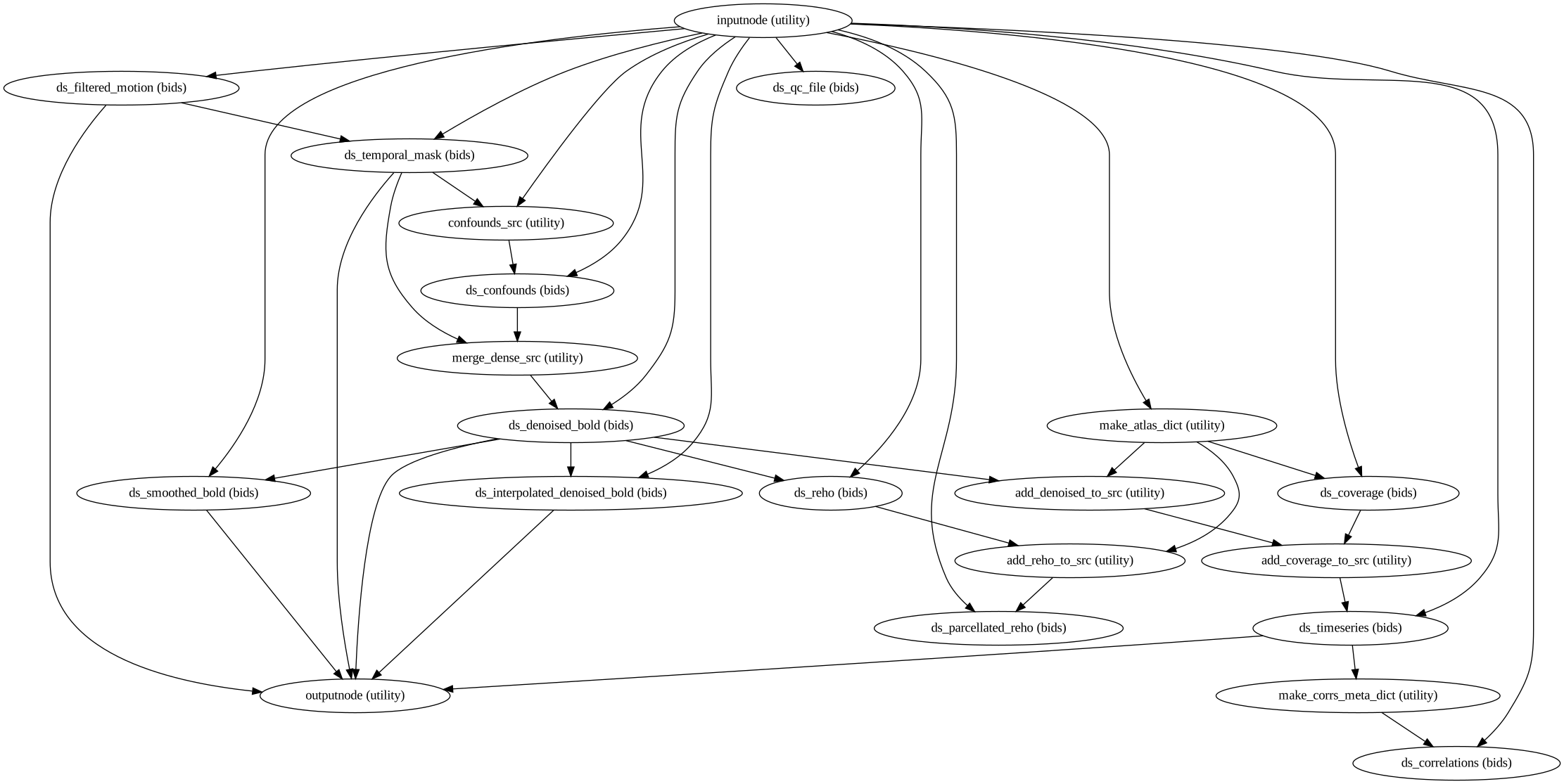
xcp_d.workflows.outputs.init_postproc_derivatives_wf
- xcp_d.workflows.outputs.init_postproc_derivatives_wf(name_source, source_metadata, fmri_dir, bandpass_filter, low_pass, high_pass, bpf_order, fd_thresh, motion_filter_type, smoothing, params, exact_scans, cifti, dcan_qc, output_dir, custom_confounds_file, name='postproc_derivatives_wf')[source]
Write out the xcp_d derivatives in BIDS format.
- Workflow Graph

(Source code, png, svg, pdf)
- Parameters:
name_source (
str) – bold or cifti filessource_metadata (
dict)fmri_dir (
str) – Path to the preprocessing derivatives.low_pass (float) – low pass filter
high_pass (float) – high pass filter
bpf_order
fd_thresh (
float) – Framewise displacement threshold for censoring, in millimeters. Any framewise displacement values higher than the threshold are flagged as “high motion”. If set to <=0, no censoring will be performed. Default is 0.2 mm.motion_filter_type ({None, “lp”, “notch”}) – Type of filter to use for removing respiratory artifact from motion regressors.
If None, no filter will be applied.
If the filter type is set to “notch”, frequencies between
band_stop_minandband_stop_maxwill be removed with a notch filter. In this case, bothband_stop_minandband_stop_maxmust be defined.If “lp”, frequencies above
band_stop_minwill be removed with a Butterworth filter. In this case, onlyband_stop_minmust be defined.smoothing (
float) – The full width at half maximum (FWHM), in millimeters, of the Gaussian smoothing kernel that will be applied to the post-processed and denoised data. ALFF and ReHo outputs will also be smoothing with this kernel.params ({“36P”, “24P”, “27P”, “acompcor”, “acompcor_gsr”, “aroma”, “aroma_gsr”, “custom”}, optional) – Shorthand for the parameter set to extract from the confounds TSV. Default is “36P”, most expansive option.
exact_scans (
listofint, optional) – If used, this parameter will produce correlation matrices limited to each requested amount of time. If there is more than the required amount of low-motion data, then volumes will be randomly selected to produce denoised outputs with the exact amounts of time requested. If there is less than the required amount of ‘good’ data, then the run will not be post-processed.cifti (
bool) – Post-process surface data (CIFTIs) instead of volumetric data (NIFTIs). This parameter is overridden when DCAN- or HCP-format data are provided. Default is False.dcan_qc (
bool) – This flag determines if DCAN-related QC steps will be taken. Enabling this flag will trigger the following steps:Brainsprite figures will be generated.
The executive summary will be generated.
DCAN QC files will be generated.
output_dir (
str) – output directorycustom_confounds_file – Only used for Sources metadata.
name (
str, optional) – Name of the workflow. This is used for working directories and workflow graphs. Default is “connectivity_wf”.
- Inputs:
atlas_names (
listofstr) – A list of atlases used for parcellating the BOLD data. The list of atlas names is generated byxcp_d.utils.atlas.get_atlas_names(). The atlases include: “4S156Parcels”, “4S256Parcels”, “4S356Parcels”, “4S456Parcels”, “4S556Parcels”, “4S656Parcels”, “4S756Parcels”, “4S856Parcels”, “4S956Parcels”, “4S1056Parcels”, “Glasser”, “Gordon”, “Tian”, and “HCP”. Used for indexingtimeseriesandcorrelations.atlas_files
timeseries (
listofstr) – List of paths to atlas-specific time series TSV files. These time series are produced from thecensored_denoised_boldoutputs.correlations (
listofstr) – List of paths to atlas-specific ROI-to-ROI correlation TSV files. These correlations are produced from thetimeseriesoutputs.coverage (
listofstr) – List of paths to atlas-specific coverage TSV files.timeseries_ciftis (
listofstr) – List of paths to atlas-specific time series CIFTI (ptseries) files. These time series are produced from thecensored_denoised_boldoutputs.correlation_ciftis (
listofstr) – List of paths to atlas-specific ROI-to-ROI correlation CIFTI (pconn) files. These correlations are produced from thetimeseries_ciftioutputs.coverage_ciftis (
listofstr) – List of paths to atlas-specific coverage CIFTI (pscalar) files.qc_file – LINC-style quality control file
interpolated_filtered_bold (
str) – Path to the censored, denoised, interpolated, and filtered BOLD file. This file is the result of denoising the censored preprocessed BOLD data, followed by cubic spline interpolation and band-pass filtering.This output should not be used for analysis. It is primarily for DCAN QC plots.
censored_denoised_bold (
str) – Path to the censored, denoised, interpolated, filtered, and re-censored BOLD file. This file is the result of denoising the censored preprocessed BOLD data, followed by cubic spline interpolation, band-pass filtering, and re-censoring.This output is the primary derivative for analysis.
smoothed_denoised_bold (
str) – Path to the censored, denoised, interpolated, filtered, re-censored, and smoothed BOLD file. This file is the result of denoising the censored preprocessed BOLD data, followed by cubic spline interpolation, band-pass filtering, re-censoring, and spatial smoothing.alff – alff nifti
parcellated_alff
smoothed_alff – smoothed alff
reho
parcellated_reho
confounds_file
confounds_metadata
filtered_motion (
str) – Framewise displacement timeseries, potentially after bandstop or low-pass filtering. This is a TSV file with one column: ‘framewise_displacement’.motion_metadata
temporal_mask (
str) – Temporal mask; all values abovefd_threshset to 1. This is a TSV file with one column: ‘framewise_displacement’.temporal_mask_metadata
dummy_scans (
intor “auto”) – Number of volumes to remove from the beginning of each run. If set to ‘auto’, xcp_d will extract non-steady-state volume indices from the preprocessing derivatives’ confounds file.