xcp_d.workflows.connectivity module
Workflows for extracting time series and computing functional connectivity.
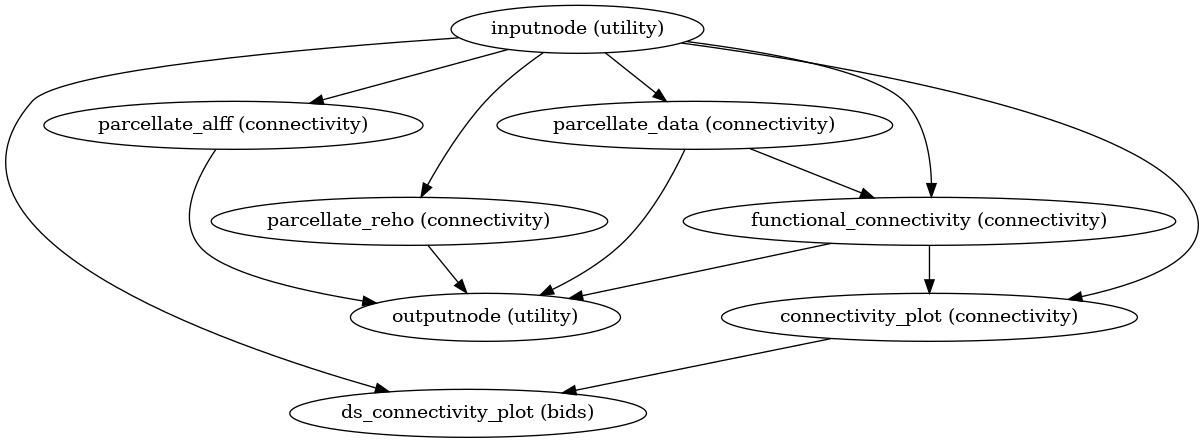
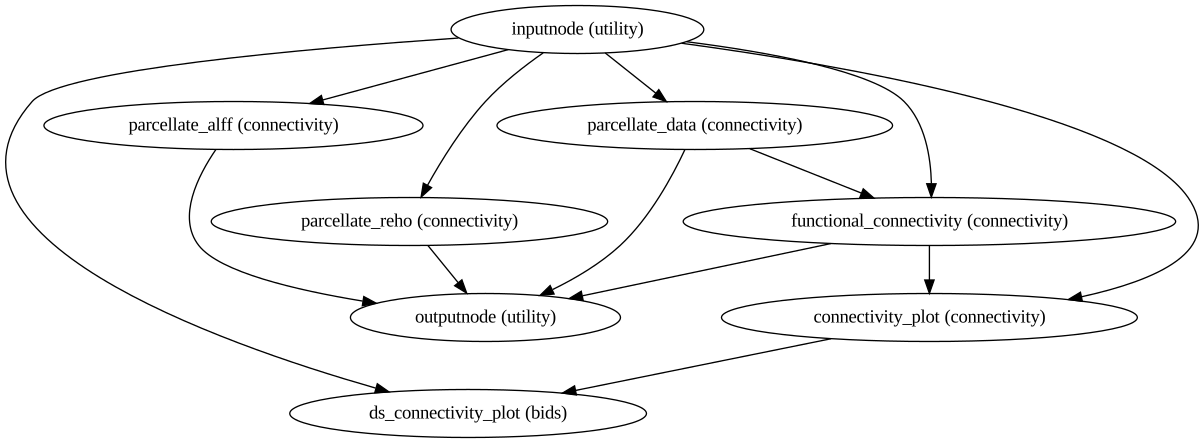
- xcp_d.workflows.connectivity.init_functional_connectivity_cifti_wf(output_dir, alff_available, min_coverage, mem_gb, omp_nthreads, name='connectivity_wf')[source]
Extract CIFTI time series.
- Workflow Graph
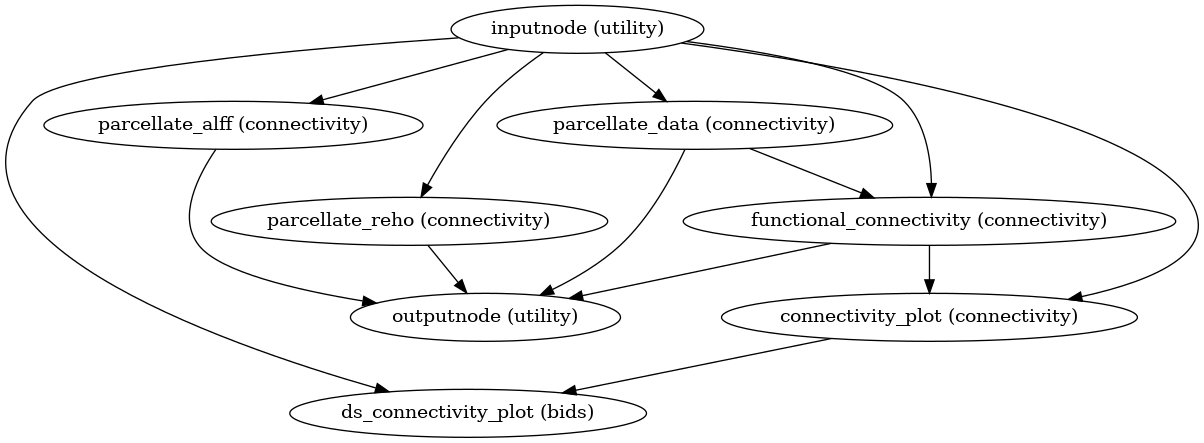
(Source code, png, svg, pdf)
- Parameters:
output_dir (
str) – Path to the output directory forxcp_dderivatives. This should not include thexcp_dfolder. For example, “/path/to/dset/derivatives/”.alff_available
min_coverage (
float) – Coverage threshold to apply to parcels in each atlas. Any parcels with lower coverage than the threshold will be replaced with NaNs. Must be a value between zero and one. Default is 0.5.mem_gb (
float) – Memory limit, in gigabytes.omp_nthreads (
int) – Maximum number of threads an individual process may use.name (
str, optional) – Name of the workflow. This is used for working directories and workflow graphs. Default is “connectivity_wf”.
- Inputs:
name_source (
str) – Path to the file that will be used as thesource_filefor derivatives. This is generally the preprocessed BOLD file. This file does not need to exist (e.g., in the case of a concatenated version of the filename).denoised_bold – Clean CIFTI after filtering and nuisance regression. The CIFTI file is in the same standard space as the atlases, so no transformations will be applied to the data before parcellation.
temporal_mask (
str) – Temporal mask; all values abovefd_threshset to 1. This is a TSV file with one column: ‘framewise_displacement’.alff
reho
atlas_names (
listofstr) – A list of atlases used for parcellating the BOLD data. The list of atlas names is generated byxcp_d.utils.atlas.get_atlas_names(). The atlases include: “4S156Parcels”, “4S256Parcels”, “4S356Parcels”, “4S456Parcels”, “4S556Parcels”, “4S656Parcels”, “4S756Parcels”, “4S856Parcels”, “4S956Parcels”, “4S1056Parcels”, “Glasser”, “Gordon”, “Tian”, and “HCP”.atlas_files
atlas_labels_files
parcellated_atlas_files
- Outputs:
coverage_ciftis (
listofstr) – List of paths to atlas-specific coverage CIFTI (pscalar) files.timeseries_ciftis (
listofstr) – List of paths to atlas-specific time series CIFTI (ptseries) files. These time series are produced from thecensored_denoised_boldoutputs.correlation_ciftis (
listofstr) – List of paths to atlas-specific ROI-to-ROI correlation CIFTI (pconn) files. These correlations are produced from thetimeseries_ciftioutputs.correlation_ciftis_exact
coverage (
listofstr) – List of paths to atlas-specific coverage TSV files.timeseries (
listofstr) – List of paths to atlas-specific time series TSV files. These time series are produced from thecensored_denoised_boldoutputs.correlations (
listofstr) – List of paths to atlas-specific ROI-to-ROI correlation TSV files. These correlations are produced from thetimeseriesoutputs.correlations_exact
parcellated_reho
parcellated_alff
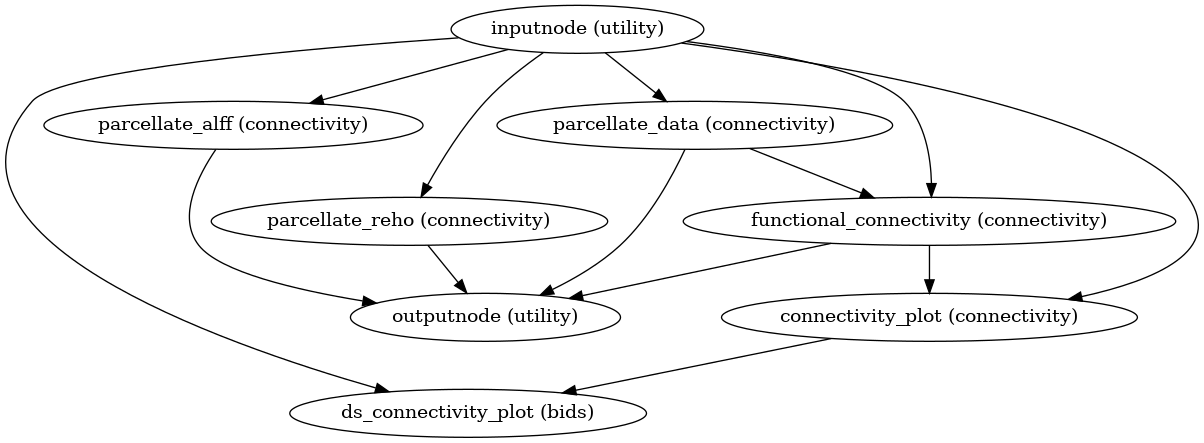
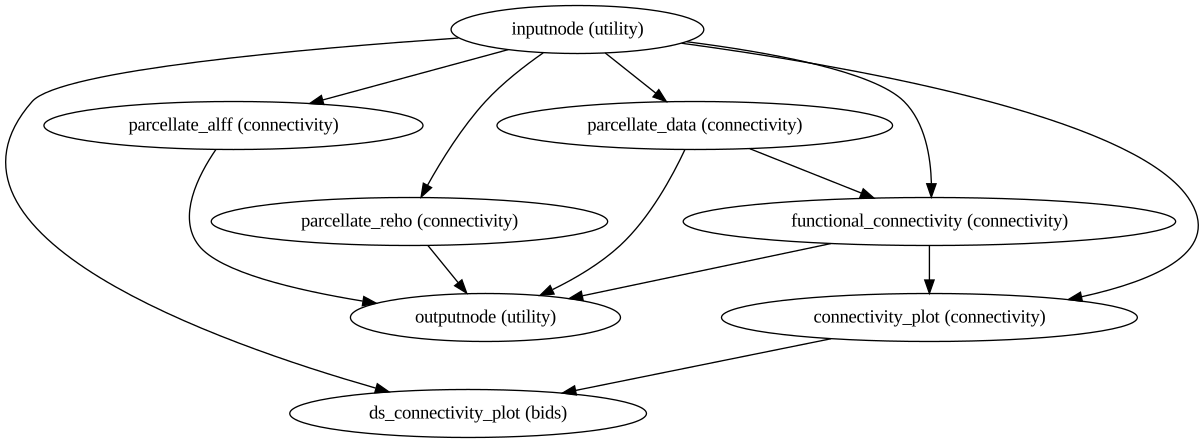
- xcp_d.workflows.connectivity.init_functional_connectivity_nifti_wf(output_dir, alff_available, min_coverage, mem_gb, name='connectivity_wf')[source]
Extract BOLD time series and compute functional connectivity.
- Workflow Graph
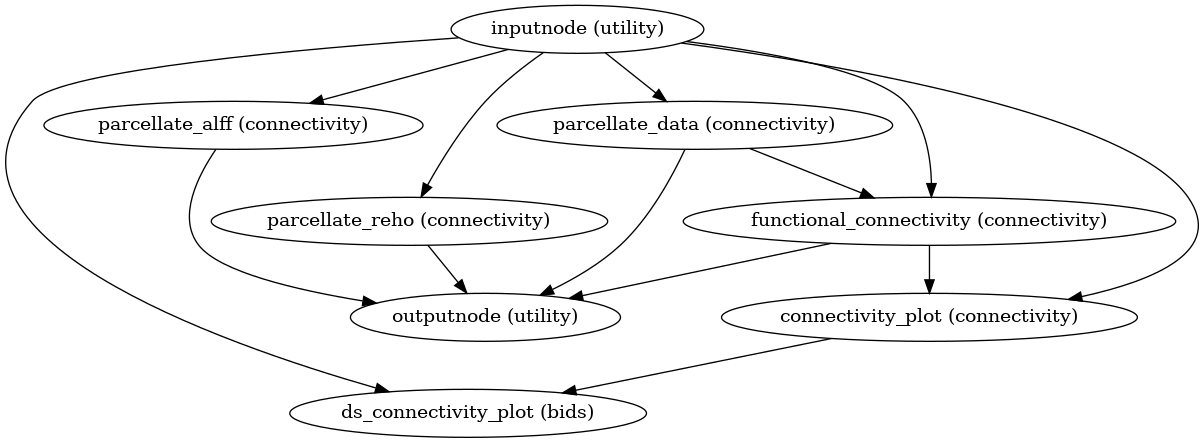
(Source code, png, svg, pdf)
- Parameters:
output_dir (
str) – Path to the output directory forxcp_dderivatives. This should not include thexcp_dfolder. For example, “/path/to/dset/derivatives/”.alff_available
min_coverage (
float) – Coverage threshold to apply to parcels in each atlas. Any parcels with lower coverage than the threshold will be replaced with NaNs. Must be a value between zero and one. Default is 0.5.mem_gb (
float) – Memory limit, in gigabytes.name (
str, optional) – Name of the workflow. This is used for working directories and workflow graphs. Default is “connectivity_wf”.
- Inputs:
name_source (
str) – Path to the file that will be used as thesource_filefor derivatives. This is generally the preprocessed BOLD file. This file does not need to exist (e.g., in the case of a concatenated version of the filename).denoised_bold – clean bold after filtered out nuisscance and filtering
temporal_mask (
str) – Temporal mask; all values abovefd_threshset to 1. This is a TSV file with one column: ‘framewise_displacement’.alff
reho
atlas_names (
listofstr) – A list of atlases used for parcellating the BOLD data. The list of atlas names is generated byxcp_d.utils.atlas.get_atlas_names(). The atlases include: “4S156Parcels”, “4S256Parcels”, “4S356Parcels”, “4S456Parcels”, “4S556Parcels”, “4S656Parcels”, “4S756Parcels”, “4S856Parcels”, “4S956Parcels”, “4S1056Parcels”, “Glasser”, “Gordon”, “Tian”, and “HCP”.atlas_files
atlas_labels_files
- Outputs:
coverage (
listofstr) – List of paths to atlas-specific coverage TSV files.timeseries (
listofstr) – List of paths to atlas-specific time series TSV files. These time series are produced from thecensored_denoised_boldoutputs.correlations (
listofstr) – List of paths to atlas-specific ROI-to-ROI correlation TSV files. These correlations are produced from thetimeseriesoutputs.correlations_exact (
listoflistofstr) – Exact-scan-wise list of lists of paths to atlas-specific ROI-to-ROI correlation TSV files. These correlations are produced from thetimeseriesoutputs and thetemporal_maskinput.parcellated_alff
parcellated_reho
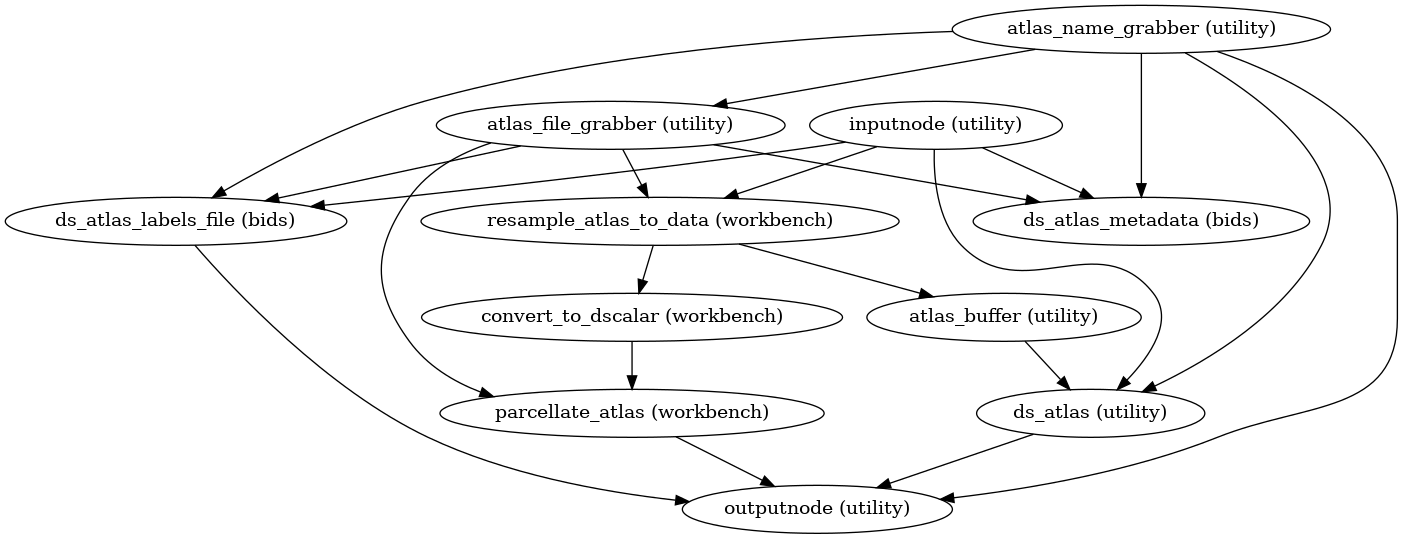
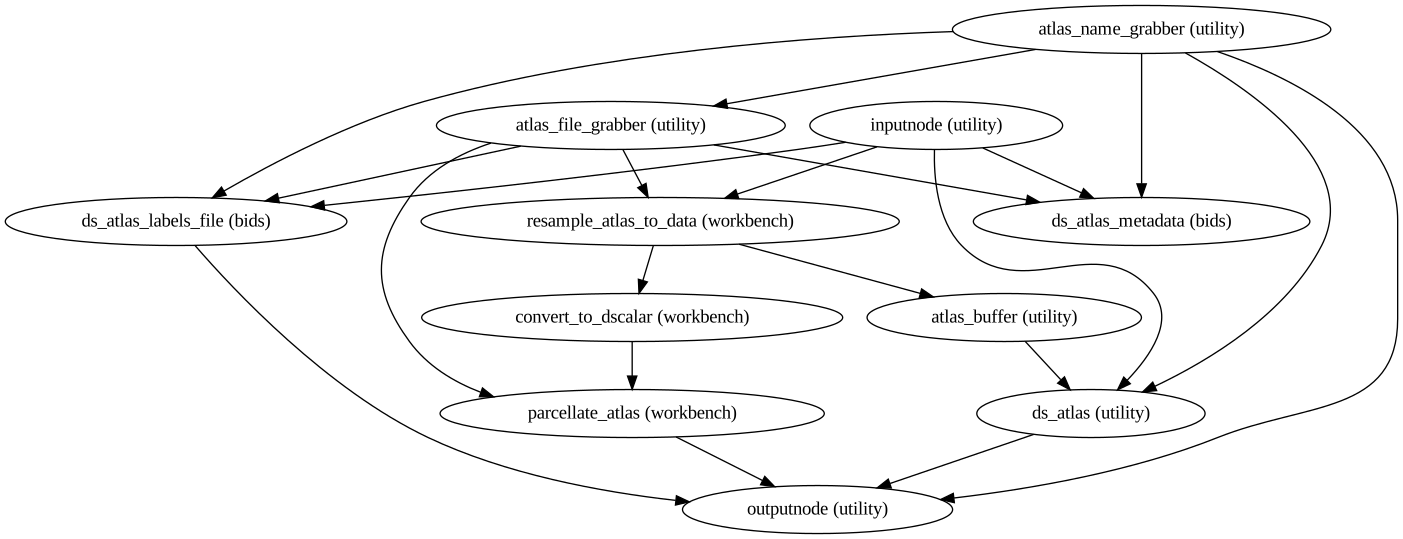
- xcp_d.workflows.connectivity.init_load_atlases_wf(output_dir, cifti, mem_gb, omp_nthreads, name='load_atlases_wf')[source]
Load atlases and warp them to the same space as the BOLD file.
- Workflow Graph
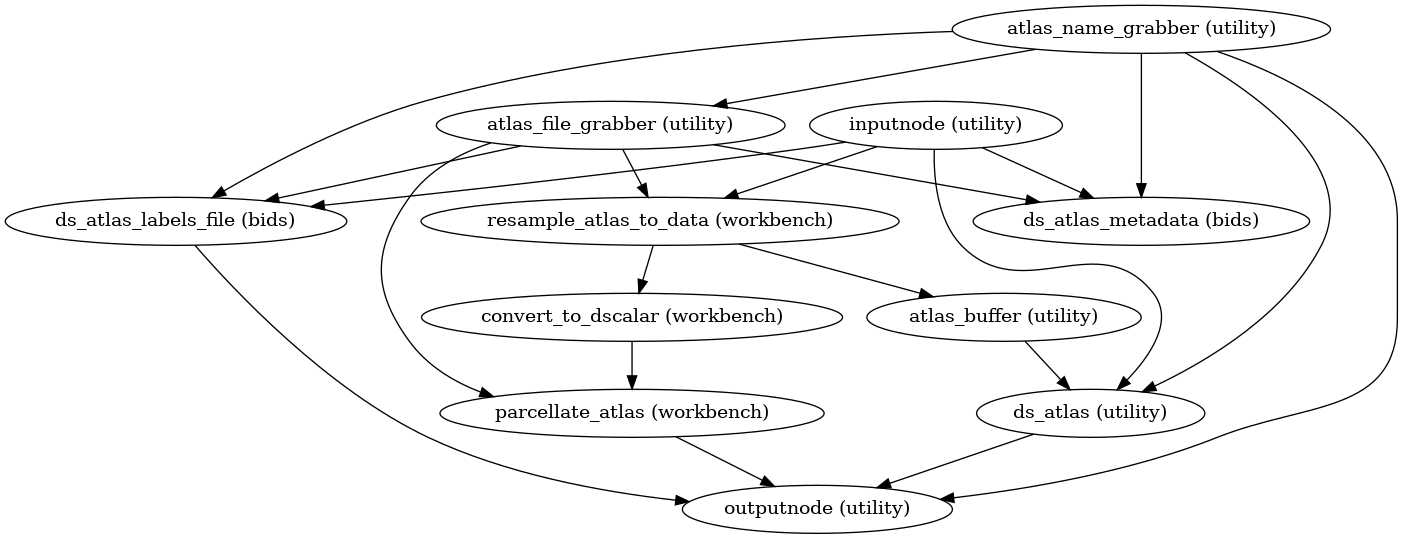
(Source code, png, svg, pdf)
- Parameters:
output_dir (
str) – Path to the output directory forxcp_dderivatives. This should not include thexcp_dfolder. For example, “/path/to/dset/derivatives/”.cifti (
bool) – Post-process surface data (CIFTIs) instead of volumetric data (NIFTIs). This parameter is overridden when DCAN- or HCP-format data are provided. Default is False.mem_gb (
float) – Memory limit, in gigabytes.omp_nthreads (
int) – Maximum number of threads an individual process may use.name (
str, optional) – Name of the workflow. This is used for working directories and workflow graphs. Default is “load_atlases_wf”.
- Inputs:
name_source (
str) – Path to the file that will be used as thesource_filefor derivatives. This is generally the preprocessed BOLD file. This file does not need to exist (e.g., in the case of a concatenated version of the filename).bold_file
- Outputs:
atlas_names
atlas_files
atlas_labels_files
parcellated_atlas_files
- xcp_d.workflows.connectivity.init_parcellate_surfaces_wf(output_dir, files_to_parcellate, min_coverage, mem_gb, omp_nthreads, name='parcellate_surfaces_wf')[source]
Parcellate surface files and write them out to the output directory.
- Workflow Graph

(Source code, png, svg, pdf)
- Parameters:
output_dir (
str) – Path to the output directory forxcp_dderivatives. This should not include thexcp_dfolder. For example, “/path/to/dset/derivatives/”.files_to_parcellate (
listofstr) – List of surface file types to parcellate (e.g., “sulcal_depth”, “sulcal_curv”, “cortical_thickness”).min_coverage (
float) – Coverage threshold to apply to parcels in each atlas. Any parcels with lower coverage than the threshold will be replaced with NaNs. Must be a value between zero and one. Default is 0.5.mem_gb (
float) – Memory limit, in gigabytes.omp_nthreads (
int) – Maximum number of threads an individual process may use.name (
str, optional) – Name of the workflow. This is used for working directories and workflow graphs.
- Inputs:
sulcal_depth
sulcal_curv
cortical_thickness
cortical_thickness_corr
myelin
myelin_smoothed

